Prof. G. Sabarinathan’s take on the life and learnings of celebrated investor Rakesh Jhunjhunwala
Prof. G. Sabarinathan, Retd. Professor of Finance and Accounting at IIM Bangalore and current Programme Director of the Fintech Programme, engages with Nandini Vijayaraghavan’s Rare: Investing the Rakesh Jhunjhunwala Way to offer up his well-rounded and unbridled review of the biography of a celebrated investor. The richly documented narrative of India’s market transformation, with scholarly precision and practitioner insight, explores how Jhunjhunwala’s journey mirrors the evolution of Indian finance, offering readers both a study in investing and a concise history of a defining economic era, notes Professor.
By G.Sabarinathan[1]
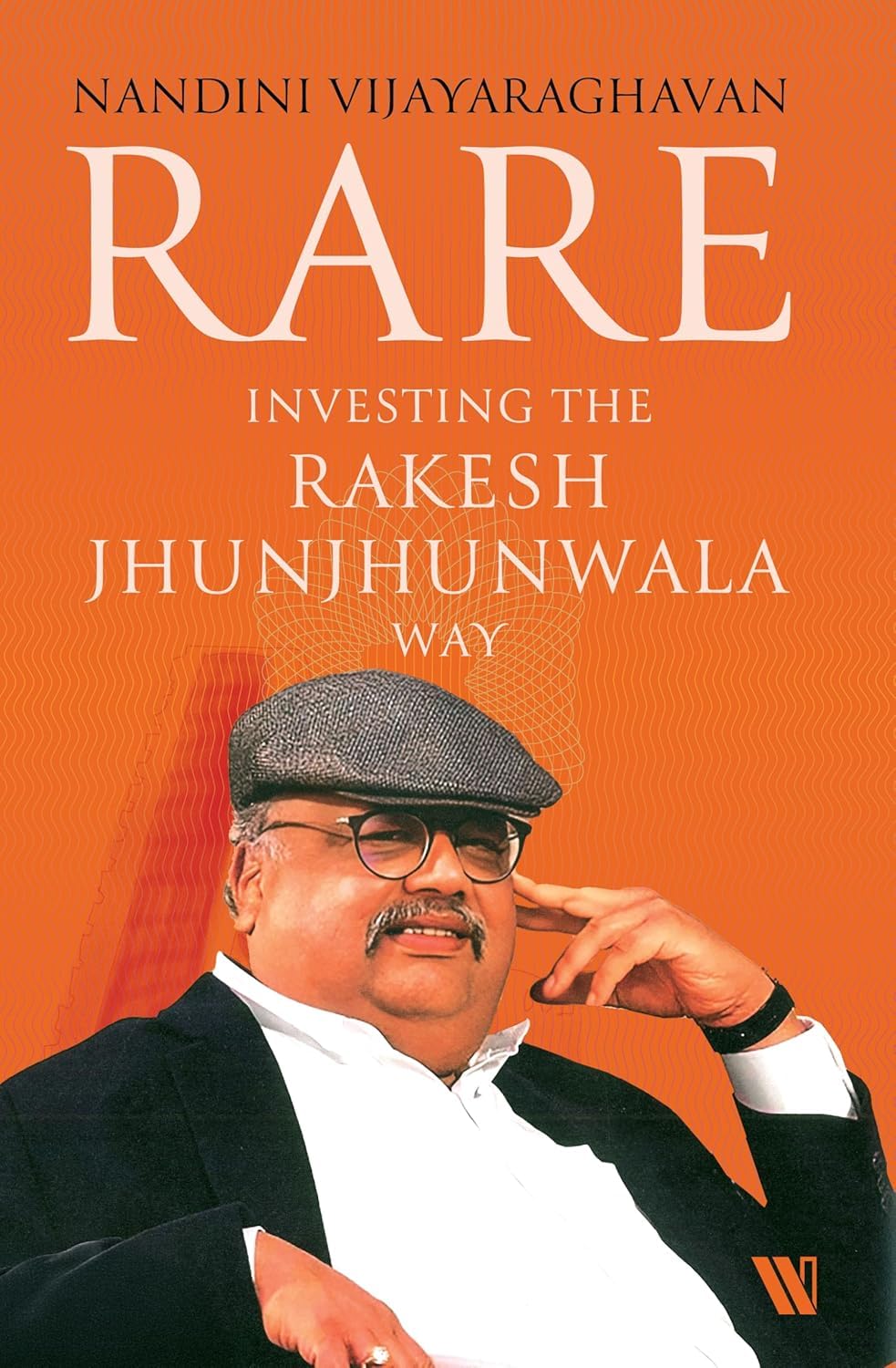
Biographies are among the more difficult genres of writing. Apart from the research required, the biographer has to be objective, without being unduly critical or hagiographical. Nandini Vijayaraghavan’s Rare: Investing the Rakesh Jhunjhunwala Way (Rare), published by Westland Business, accomplishes that feat remarkably.
What is more, it offers a remarkable view of the Indian securities market from 1985 to 2002, the period that Rakesh Jhunjhunwala (RJ), the subject of Rare, was active as an investor.
Rare seems to be the fourth book on RJ, leaving aside an Ashoka University publication that Vijayaraghavan cites, which does not seem to be available for purchase. The author explains at the outset her motivation for writing the book.
Exhaustive analysis of RJ’s investment portfolio
What must make the book among the most exhaustive, if not the most, is the extent of effort that has gone into tracing the build-up of RJ’s portfolio and the fluctuations in its value, sometimes quarter on quarter, over multiple years.
That is no easy task considering that there is limited information on the price and quantity of many of RJ’s sales and purchases of even those shares that account for a sizeable part of the portfolio. Calculating the return on RJ’s invested capital is complicated even further by the limited information on how he financed his investments.
Another distinguishing feature of the book is the coverage of RJ’s unlisted portfolio. Here again, Vijayaraghavan works hard on estimating the performance of those investments, drawing on a host of sources such as Trendlyne.
Other distinguishing features of the book
As with Vijayaraghavan’s other book, Unfinished Business, Rare is a book every student of business should read for the many valuable insights it offers into the banking, insurance, and watch and jewellery industries.
Her cross-referencing a rating agency’s observations on the financial position of Star Health Insurance with the actual financial results of the company, just prior to its Initial Public Offering (IPO), is just one example of the rigour in the research.
Vijayaraghavan’s concise history of the market from the eighties to the economic liberalisation includes brief yet informative accounts of the scams associated with Harshad Mehta and Ketan Parekh, which can provide a valuable background for practitioners who entered the market in the twenty-first century.
The book also provides a comparative analysis of the portfolios of RJ’s principal contemporaries, such as Madhusudan Kela, RK Damani, Ramesh Damani and Nimesh Shah. RJ towers above all of them, including RK Damani, when adjusted for his wealth from Avenue Supermarkets, which operates the DMart Chain, which RK Damani owns.
RJ vs the Oracle of Omaha
RJ has been referred to as the Warren Buffett of India. But there have been important differences, as well as similarities, between the two, many of them attributable to the markets they invested in.
As Vijayaraghavan notes, both are products of the historical context in the markets they invested in. Both believed in investing for the very, very, long long term. They based their investment decisions on the quality of the management team they were backing and the fundamentals of the industry.
At the same time, RJ was an inveterate trader who accumulated his capital through a careful and inimitable management of highly risky leveraged positions that the firm chose not to continue after his passing.
If Buffett communicated a lot more through his annual letters, RJ stood out for his faith in the Indian economy and his effort to broaden the interest in and awareness about investing.
While Buffett had commented on issues of a political nature, RJ proclaimed his active support for the Bharatiya Janata Party. Vijayaraghvan notes that RJ was also a great believer in India as a nation and was eager to see more of domestic capital flow into the Indian markets and reduce the dependence on foreign fund flows.
A shorter narration?
As one worked through the 308 pages of the book, one could not help wondering if it could not have been shorter, shorn of some of the industry and market-related context. But then that would probably not be a book Vijayaraghavan might write, given her background in translating context-rich classics like Kalki’s Sivagamiyin Sabadam.
For the effort Vijayaraghavan has put into writing this book, it deserves better editing support from the publishers.
On balance, Rare is a profoundly important piece of work, a double treat. It is not merely an account of RJ’s investing activities. It is the history of a crucial period in the Indian financial markets. As Ramesh Damani observed, “The story of his [RJ’s] life is the history of India’s capital markets”.