
Five days of ideas, conversations, classroom insights and experiences that brought French business and culture to life
The second cohort of EPGP ’27 spent 17th to 21st August 2026 in Paris as part of its International Immersion at ESSEC Business School. Accompanied by Prof. Amar Sapra, Chairperson, EPGP, the cohort’s first five days brought together classroom sessions, conversations with entrepreneurs and business leaders, industry visits and an excursion to the Champagne region.
Across these experiences, the cohort explored questions that went well beyond business frameworks — how culture shapes leadership, how geopolitics influences business decisions, what it takes to build and scale a startup, how a centuries-old industry creates and protects its value, and where good strategy really comes from.
Here is a look back at five eventful days in Paris, as experienced by the cohort.
Day 1: Intercultural Communication and Global Leadership
The immersion began at ESSEC with a session on intercultural communication and global leadership, led by Alexander Wurz. At the heart of the discussion was the idea of the “intercultural detective” – a leader who approaches cultural differences with curiosity, asks questions, listens carefully and resists the urge to judge unfamiliar behaviour too quickly.
The session explored how culture extends well beyond nationality. Organizational, generational, regional, professional and personal cultures all influence the way people communicate, make decisions and work together. A comparison of German and French approaches to project management illustrated this vividly. German teams may favour detailed planning and clearly defined objectives, whereas French teams may allow objectives to evolve as new possibilities emerge. Neither approach is inherently superior; understanding the context behind each is what enables diverse teams to work effectively.
The discussion then moved to the human side of cross-border mergers. Beyond financial and strategic considerations, mergers can create uncertainty, rumours and anxiety among employees, often leading to the loss of talented people. Building trust through open communication, cultural understanding, individual conversations and team-building therefore becomes critical t1o successful integration.
The cohort also examined why multicultural teams can sometimes outperform homogeneous ones, despite taking longer to establish effective ways of working. The difference, the session suggested, lies in how leaders manage diversity.
The day concluded with a discussion on perception and unconscious bias built around the iceberg model. The central message reinforced was the five golden rules of intercultural communication: don’t jump to conclusions, lead with empathy, adapt to the other culture, stay authentic and don’t overplay it, and communicate by making the invisible explicit.
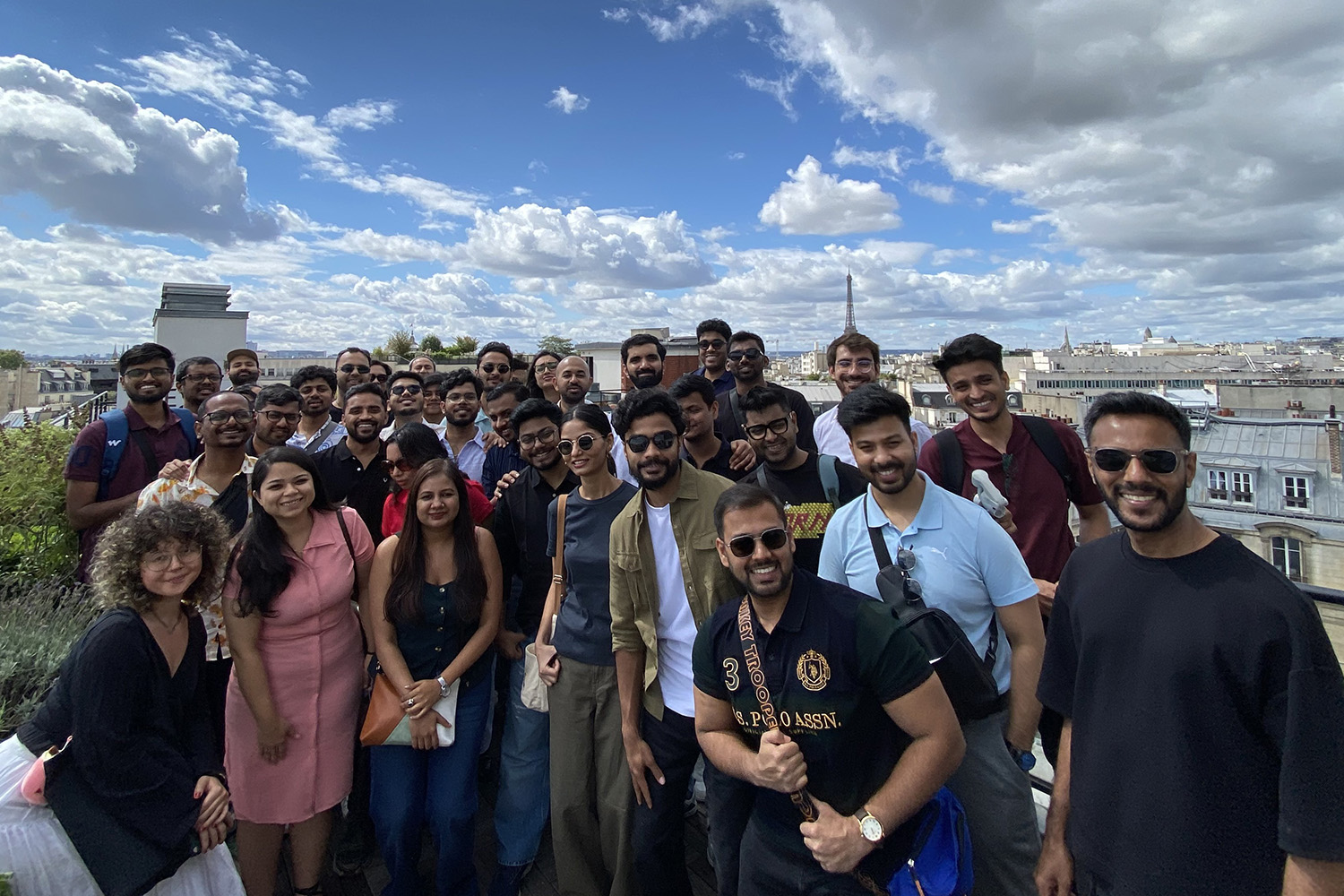 The second cohort of EPGP ’27 during the first day of their international immersion at ESSEC Business School, France.
DAY 2: Geopolitics and Business
Day two examined a reality increasingly confronting business leaders: geopolitics is no longer something that happens outside the boardroom.
Cedomir Nestorovic, who teaches geopolitics and business and is based at ESSEC’s Singapore campus, led the cohort through examples of companies navigating sanctions, supply-chain vulnerabilities, political risk and changing global alliances. Discussions around Russia, China, the Middle East and de-dollarization demonstrated how geopolitical developments can directly affect decisions about markets, suppliers, investments and corporate strategy.
China emerged as a recurring theme. The concept of ‘China plus one’, which concept of retaining a presence in China while developing an additional manufacturing or supply base, prompted comparisons between India, Vietnam, Mexico and Morocco. The discussion highlighted the trade-offs companies face between talent, infrastructure, speed of decision-making, market access and political stability.
The cohort also explored China’s remarkable transformation from a manufacturing base into an innovation and technology powerhouse, alongside the demographic pressures driving its investment in automation and robotics.
The afternoon broadened the discussion from business decisions to the nature of geopolitical power itself. Students examined classical geopolitics through ideas of geography, states and hard and soft power, before turning to critical and feminist perspectives that place greater emphasis on narratives, identity and individual and collective sovereignty.
The session ultimately returned to a fundamental principle of geopolitics: interests, rather than permanent alliances, often determine relationships. For business leaders, understanding those interests and anticipating how they may shift is increasingly essential.
DAY 3: Startup Ecosystem, Entrepreneurship and Funding
Day three took the cohort outside the classroom and into the heart of France’s startup ecosystem, with visits to Le Village by CA, ColibriTD and Bpifrance, breaking for lunch at Parisian hotspot Tiger’s Milk.
At Le Village by CA, students were introduced to the accelerator model developed by Crédit Agricole, one of France’s biggest banks, to support startups while connecting them with established businesses. The visit offered a glimpse into how France is building an ecosystem around entrepreneurship, combining private-sector networks with significant public support.
One interesting insight challenged the popular image of the startup founder. Rather than being fresh graduates with an idea, many founders are professionals in their mid-career who identify a problem through years of experience and decide to build a solution around it.
The cohort also heard from ColibriTD’s co-founder Laurent Giraud, a physics PhD who spent 30 years in tech (Google, Amazon Web Services, Oracle) before founding the company in 2019. The startup works on software and algorithms that make quantum computing more accessible to businesses. He spoke candidly about the realities of building a deep-tech company: conserving cash, using consulting as a bridge to fund research and development, working closely with customers to identify real use cases, and knowing when an emerging technology may become an opportunity.
A second startup, Hapster, tackled a problem specific to factories. They demonstrated how technology can preserve another form of valuable knowledge — the tacit expertise of experienced factory workers. Its platform uses video, audio and AI to capture the practical knowledge of veteran employees and make it accessible to the next generation.
The day concluded at Bpifrance, the state-owned French investment bank, presented by Valentin Marin, Head of Operations for the EuroQuity team within its international department. This is where students learnt about France’s extensive public financing infrastructure for startups, SMEs and larger industrial businesses. The visit highlighted the importance of connecting entrepreneurs not only with capital but also with markets, investors, institutions and international partners.
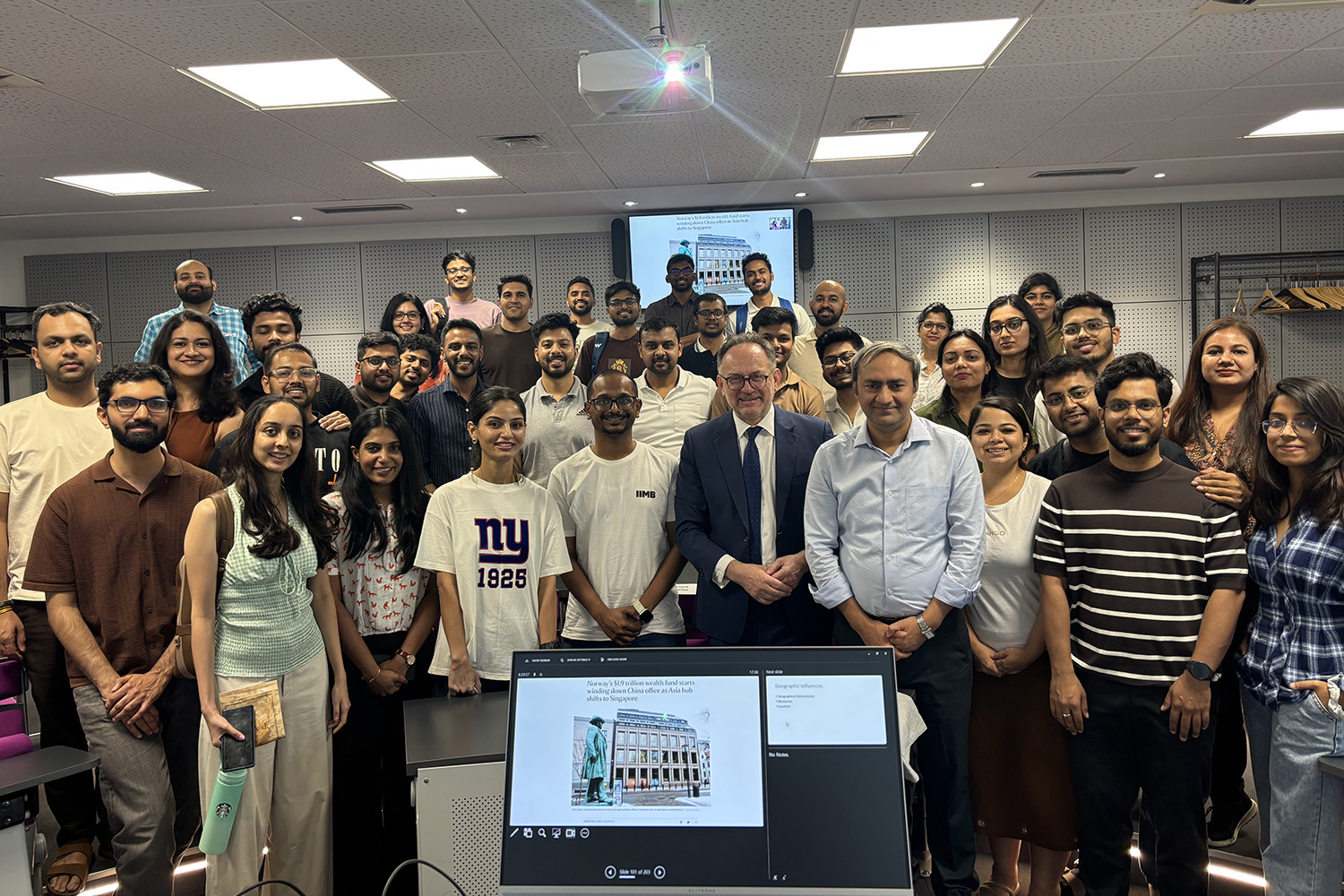 EPGP ’27 participants with Cedomir Nestorovic, following an engaging session on geopolitics and business, which delved into how global power shifts, political developments and changing alliances are shaping business decisions worldwide.
DAY 4: A Taste of Champagne
The fourth day took the cohort beyond Paris to the Champagne region, where a visit to Le Clos Corbier and the Mercier champagne house in Epernay offered a very different perspective on business.
The day began among the vineyards, where students learnt about the region’s three principal grape varieties, the champagne-making process and the impact of changing weather patterns on harvests. But the bigger lesson was that Champagne is as much a story of business, branding and market creation as it is of agriculture.
The history of Champagne demonstrated how an entire industry can be shaped by trade, consumer preferences and storytelling. The emergence of champagne houses, the role of England as a major market and the development of distinctive brands all contributed to transforming a regional product into a global luxury category.
The cohort also explored how the industry manages supply and demand. Maintaining reserves, managing production and relying heavily on non-vintage blends help producers maintain consistency even when individual harvests vary.
The visit offered several reminders about the power of branding. The story of Dom Pérignon, for instance, showed how historical narratives can evolve into powerful commercial identities.
The students finished the day at Mercier in Epernay, on the Avenue de Champagne, which the guide called the most valuable avenue in the world, with hundreds of kilometres of cellars and over half a billion bottles ageing beneath it. Mercier, founded by Eugene Mercier in the 19th century and now part of LVMH, is mostly sold within Europe, which is why few outside have heard of it. They toured the cellars underground by little train.
DAY 5: Strategy – A European Flavour
The final day of the Paris leg returned to the classroom, with strategy professor Jérôme Barthélemy, a longtime ESSEC strategy professor and former dean of executive education, inviting the cohort to reconsider what strategy truly entails.
The discussion was built around four questions: what strategy is, how to analyse one, where it comes from, and how to craft a new one. The core idea was that strategy is making choices, but what makes a choice strategic is that you can never be sure it is right. If it is obvious, it is operational, because everyone will do it. Genuine strategy involves committing to a direction when the outcome cannot be guaranteed.
Through cases including Nespresso and The Economist, students examined how strategy emerges from a series of interconnected choices rather than from attractive outcomes alone. The contrast with competitors such as Newsweek illustrated how imitating visible features of a successful company is not the same as replicating the underlying logic that makes its strategy work.
The IKEA case offered another perspective: some of the company’s most important strategic innovations emerged not from grand plans, but from constraints and problems encountered along the way. Flat-pack furniture, for instance, evolved from the practical challenge of transporting furniture without damage.
The afternoon turned to Blue Ocean strategy, using examples such as CitizenM and Cirque du Soleil to explore how organizations can rethink what customers value by eliminating, reducing, raising or creating different elements of an offering.
The session ended with a broader lesson on innovation: ideas often emerge by looking outside one’s own industry and combining solutions from seemingly unrelated fields.
As the first five days of the Paris immersion came to a close, the cohort left with more than a collection of business frameworks. Across classrooms, startups, institutions, vineyards and historic cellars, the experience offered different ways of looking at leadership, markets, strategy and the world in which businesses operate.
