
From German business and family-owned enterprises to start-ups, sustainability and world-class manufacturing, the EPGP cohort’s Berlin immersion offered plenty of opportunities to learn, explore and see familiar concepts in a new light
EPGP 2027 packed its bags and embarked on an exciting two-week International Immersion across three of Europe’s most dynamic cities, from 17th to 28th August 2026.
The 74-member cohort’s journey spans the history and dynamism of Berlin, the cosmopolitan pulse of Madrid and the cultural and intellectual richness of Paris, with academic engagements at ESCP Business School and ESSEC Business School forming an integral part of the experience.
The first leg of the immersion takes the cohort to ESCP Berlin, where students are accompanied by Prof. Sai Yayavaram, Strategy area, as they explore Germany’s business landscape through academic sessions, company visits and experiences across the city.
Here is a look back at their first five days in Berlin, as told by the EPGP ’27 cohort.
Day 1: Understanding Business in Germany
The immersion opened at ESCP Berlin’s Lecture Hall 2 with a welcome to the campus, followed by the first academic session on the German business landscape.
Prof. Dr. Georg Stadtmann took the cohort through how Germany rebuilt itself into Europe’s largest economy after the Second World War, and what that history explains about the way German business works today. The session covered the social market economy, the role of the Mittelstand, co-determination and the relationship between labour and capital, and Germany’s position as an export-led manufacturing power. There was plenty of room for questions and discussion, with the cohort drawing comparisons to the Indian context.
Prof. Stadtmann holds the Chair of Economics, in particular Macroeconomics, at the European University Viadrina in Frankfurt (Oder), and teaches on ESCP Berlin’s international programmes. His research spans macroeconomics, financial markets, and sports and gaming economics. He is the originator of the Gaming & Esports Research Summit, now co-hosted with ESCP Berlin.
A practical follow-on session with Mimansa Bhardwaj focused on the German labour market: work culture and workplace norms, the EU Blue Card and visa pathways, how hiring and recruiting actually work in Germany, and what international professionals should expect when they make the move.
Post-lunch, students travelled to the Indian Embassy in Berlin for a welcome speech and a visit to the mission, which provided them with a useful window into India-Germany trade and diplomatic ties.
From there, the group walked to the Reichstag and made their way into Norman Foster’s iconic glass dome. Positioned directly above the parliamentary chamber, the dome allows visitors to look down on the proceedings below and is a striking architectural expression of transparency in democracy. The view across Berlin from the top was definitely a bonus.
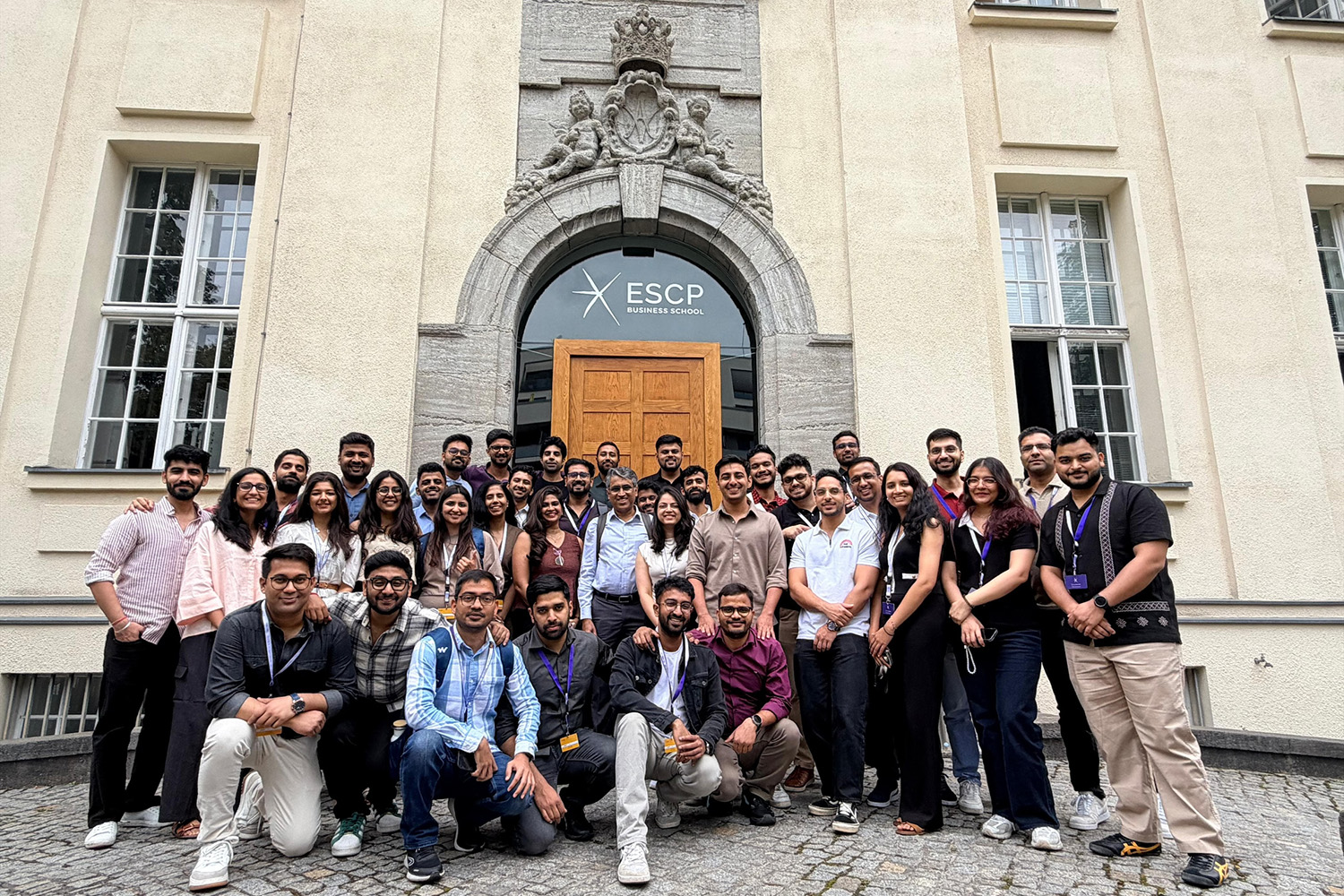 EPGP ’27 during the first day of their international immersion at ESCP Berlin.
Welcome dinner was hosted at Café Botanico in Neukölln, a German–Italian farm-to-table restaurant built around a 1,000 sqm permaculture forest garden in its own backyard. Over 200 edible plants grow roughly fifty metres from the kitchen, and it is the only organically certified garden of its size in inner-city Berlin. Founder Martin Höfft started it in 2012 on an overgrown allotment – a fitting first meal in a city that takes sustainability seriously.
Day 2: Germany’s Family Business Advantage
The second day focused on the Mittelstand, the family-owned SMEs and hidden champions that form the backbone of the German economy and quietly dominate global niches most people have never heard of.
Prof. Dr. Stefan Schmid, who holds the Chair of International Management and Strategic Management at ESCP Berlin, and is Academic Director of the Berlin Executive MBA, unpacked why these firms behave so differently from listed companies: long time horizons instead of quarterly earnings, conservative financing, deep regional roots, patient investment in apprenticeships and R&D, and succession treated as a strategic problem rather than an HR one. The students then looked at where this ownership model creates genuine competitive advantage, and where it creates fragility, particularly around digital transformation, internationalization and attracting talent. The session was case-led and interactive, with the class working through examples together.
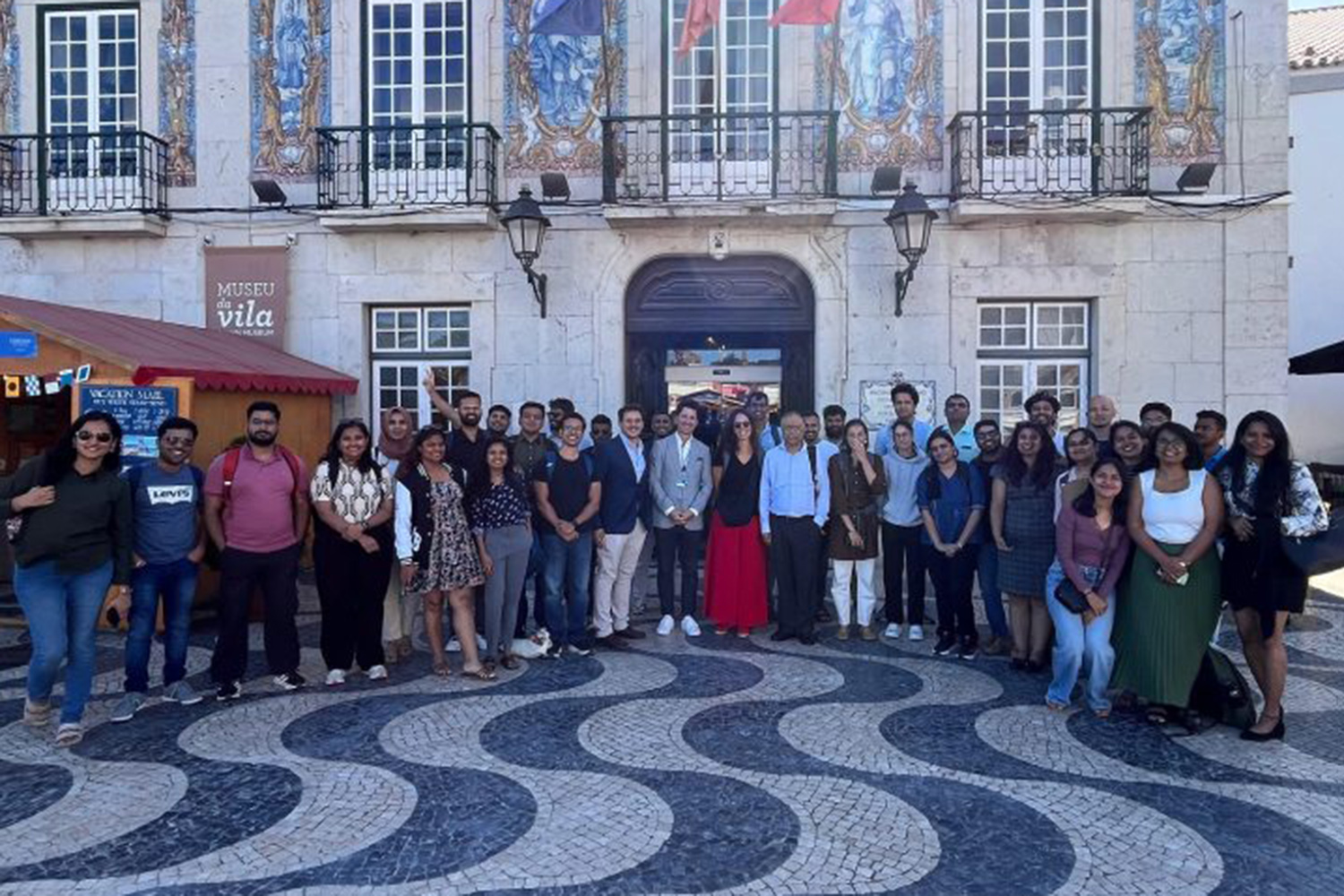 The cohort delves into the Mittelstand – family-owned SMEs and ‘hidden champions’ that form the backbone of Germany’s economy and lead global niche markets.
Post-lunch, students were part of a session on renewable energy and energy transformation. They travelled to the EUREF Campus in Berlin-Schöneberg, where Schneider Electric runs its Innovation Hub with Germany’s first micro smart grid that links solar generation, heat pumps, storage and EV charging infrastructure into a single intelligently managed system. The five-hectare EUREF campus now hosts around 150 companies, start-ups and research institutions, and roughly 7,000 people working on energy, mobility and sustainability. It met Germany’s 2050 climate targets back in 2014, thirty-six years early.
Day 3: Berlin’s Entrepreneurial Ecosystem
The third day turned to how Berlin became one of Europe’s leading start-up hubs, and what a functioning entrepreneurial ecosystem is actually made of.
The session with Chloé Ipert, doctoral researcher in Entrepreneurship at ESCP Berlin, covered the ingredients — capital, talent, infrastructure, culture and regulation — and how they compound over time. Berlin’s story is an unusual one: cheap space and a countercultural, post-reunification identity attracted founders long before the money arrived, so the capital followed the talent rather than the other way round. The students also discussed the tension between that culture and the more conservative German business establishment they were given a glimpse of the day before. It was one of the more participative sessions of the week, with group discussion and plenty of back-and-forth.
The cohort then travelled to Berlin-Spandau for a guided tour of the BMW Group Plant Berlin, the lead plant for BMW’s global motorcycle production.
The site has a remarkable history. Originally a Siemens aero engine plant, it was acquired by BMW in 1939 and has been building motorcycles since 1969. Today, around 2,200 employees produce close to 900 motorcycles a day across roughly 220,000 sqm, shipping to more than 130 countries. A finished bike comes off the line every 60 to 75 seconds, each assembled from about 2,000 parts to individual customer specification.
The logistics operation was the standout. The plant moves close to a million parts a day through an automated high-bay warehouse, with electric trains delivering to the assembly lines just in time. For a cohort that studied Operations Management earlier this year, watching mass customization, JIT and mixed-model assembly come together on the shop floor turned familiar classroom concepts into a tangible experience.
Day 4: Smart Mobility and Deep Tech
Day four turned to the future of mobility, with Prof. Dr. Alexander Eck exploring how electrification, autonomous driving and software are reshaping the automotive industry. The session examined how traditional automotive business models are evolving from one-time vehicle sales towards customer lifecycle management, from hierarchical structures to interdisciplinary teams, and from conventional supplier relationships to longer-term partnerships.
Through examples from companies such as FLEXIS, Mobileye and Aumovio, the cohort saw how software is becoming increasingly central to mobility. An interactive workshop then invited participants to consider how AI could transform different modes of transportation, beginning with existing pain points and imagining new possibilities.
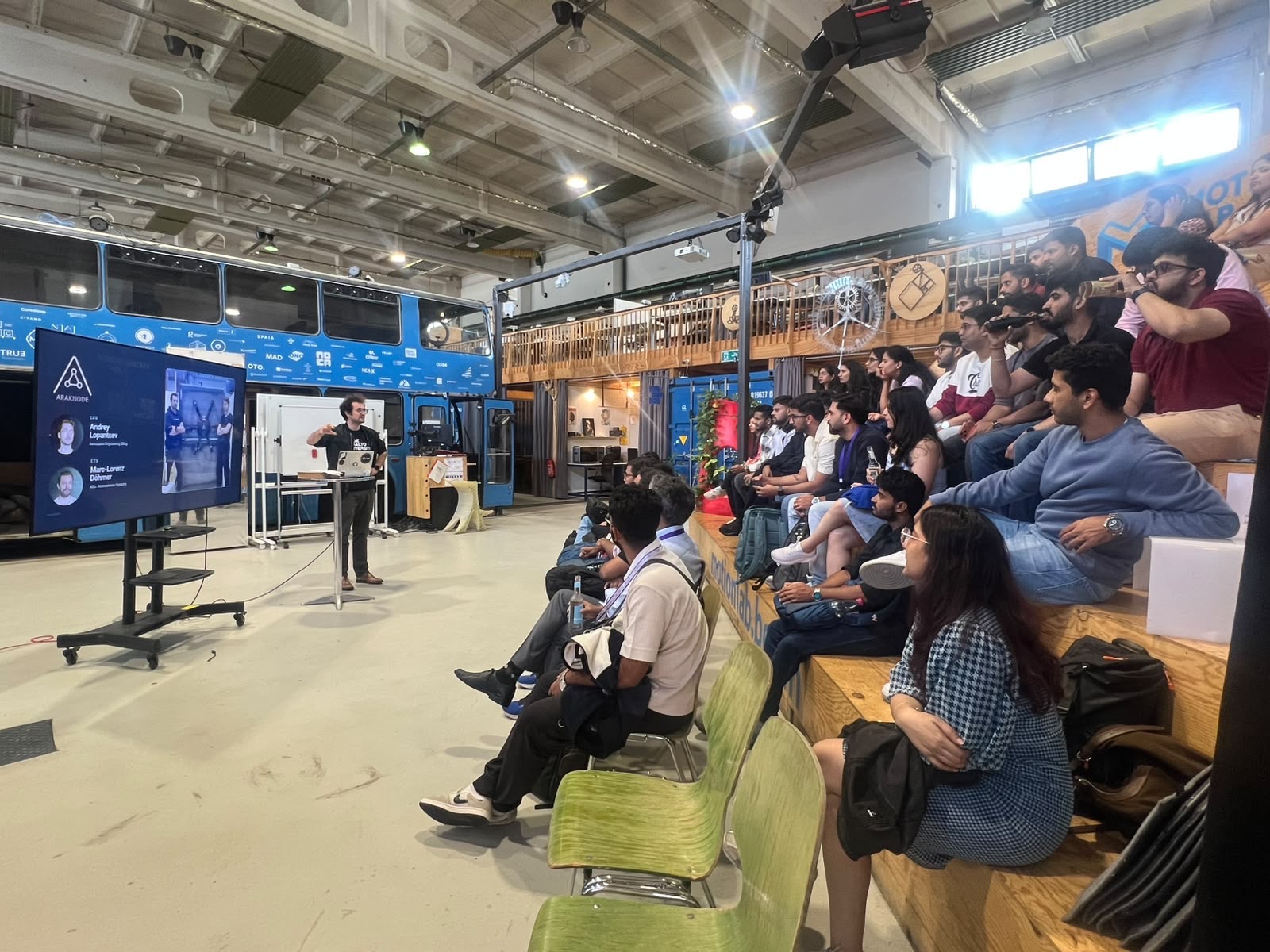 The cohort during a company visit to MotionLab.Berlin, Germany’s officially designated Deep Tech Hub and one of the largest hardware innovation spaces in Europe.
After lunch at M93 Restaurant, the students visited MotionLab.Berlin, Germany’s officially designated Deep Tech Hub and one of Europe’s major hardware innovation spaces and home to startups working across robotics, AI hardware and advanced manufacturing. A tour of its prototyping facilities (3D printing, laser cutting, and CNC machining all under one roof) made the whole idea-to-physical-product pipeline feel real in a way slides never quite manage.
Day 5: Demystifying AI and IoT
Day five in Berlin continued the exploration of technology and innovation through interesting classroom deliberations. Prof. Dr. Alexander Eck led a session on AI, IoT and the rapidly shifting technology landscape.
The session looked at how emerging technologies are creating new opportunities and challenges for businesses, while introducing the cohort to design thinking as a structured approach to innovation. Participants explored how organizations can move from identifying problems and opportunities to developing solutions that are desirable, viable, usable and feasible.
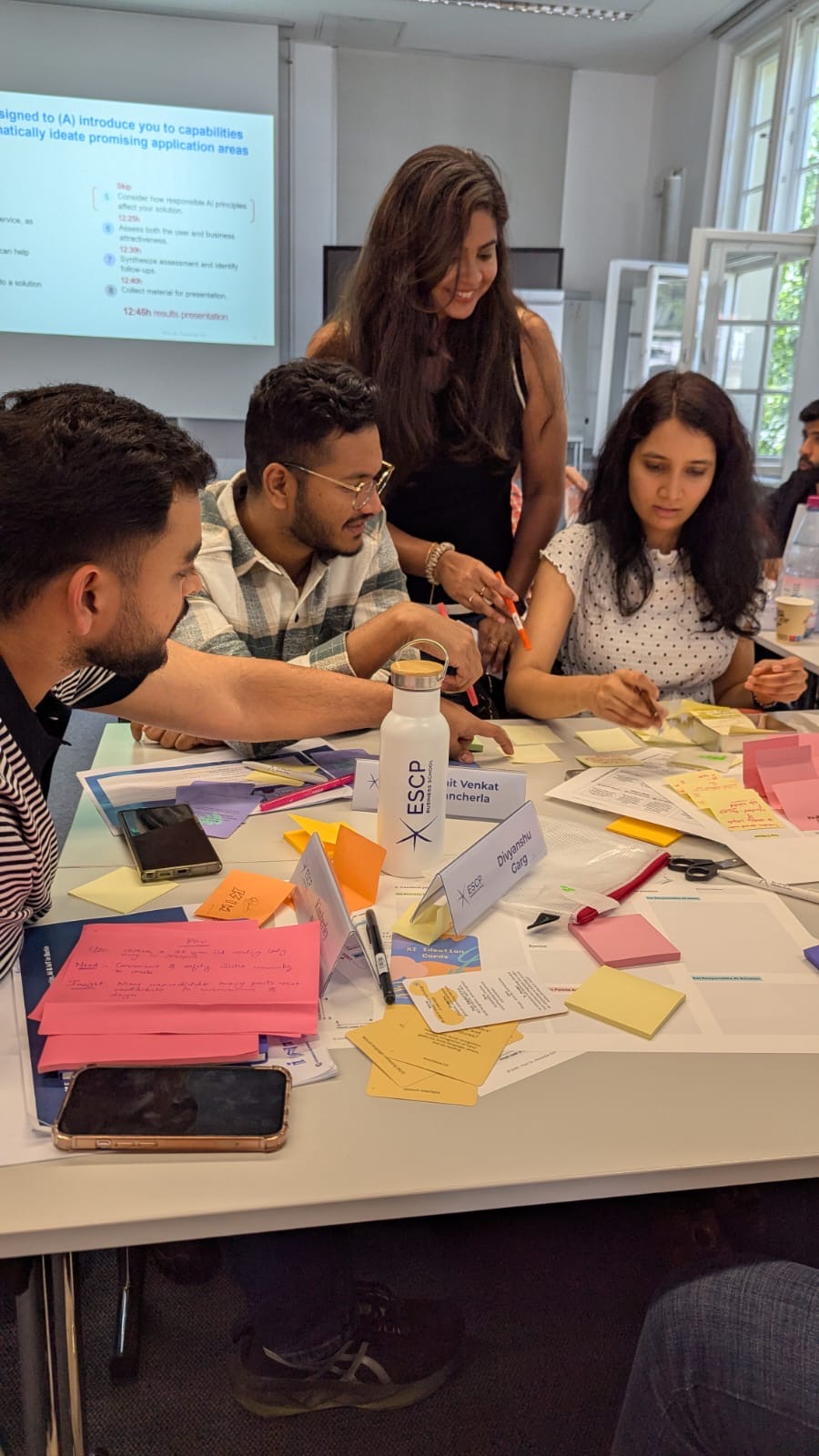 In an interactive workshop, students use innovation cards to explore how AI could transform different modes of transportation.
A practical workshop using a value proposition canvas helped the cohort apply these ideas to a ride-pooling example, examining customer needs, pain points and the ways in which products can create value.
The afternoon concluded with a visit to CarTelSol, a Berlin-based automotive technology company working at the intersection of vehicle software, hardware and connectivity. Its work in areas including digital keys and e-mobility provided a fitting close to two days of exploring how technology has transformed the mobility space.
